Showing posts with label business. Show all posts

Wednesday, 14 November 2018

Dear SBI, when will YOU move? Now, ICICI Bank hikes FD interest rates by 25 bps, senior citizens see most benefit


The fixed deposits interest rate war is in full swing, with private lender ICICI Bank being the latest one to announce an attractive hike. Interestingly, ICICI Bank's new hike is not applicable on all tenures, but some specific long-term deposit ones. Once again, it would be senior citizens, who reap the most benefit compared to the general category. Fixed deposits are the safest traditional form of investment in India. You must have been motivated by an elder to invest in FD schemes rather than taking risks with markets.
Today, ICICI Bank increased its fixed deposit interest rates by 25 basis points on less than Rs 1 crore with immediate effect. The new rates are applicable across various tenors for domestic term-deposits. It is also applicable for Non Resident Ordinary (NRO) & Non Resident External (NRE) term-deposits. 
Pranav Mishra, Senior General Manager & Head – Retail Liabilities Group, said, “With the prevailing volatility in financial market, we see renewed interest by customers to invest in fixed deposits which offer a combination of attractive interest rates, liquidity and assured returns."
Mishra added, "The 2-3 years tenor offers customers an opportunity to invest at a higher interest rate of 7.50% p.a. (8.00% p.a. for senior citizens). As a prudent asset allocation strategy, we feel customers should definitely look at capitalising on this opportunity.” 
With this hike, ICICI offers a peak interest rate of 7.50% on term-deposits with a maturity of above 2 years upto 3 years. 
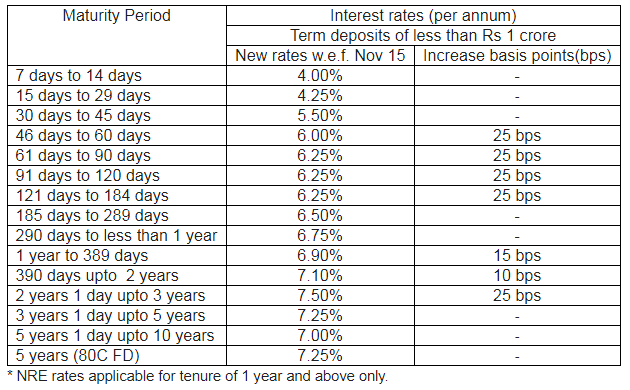
ICICI Bank offers term-deposits with various maturities starting as low as 7 days and up to 10 years. It also offers a 50 basis points higher interest rate to senior citizens across term-deposits of all maturities.  
The bank in its notification said, "Customers can open a term-deposit at any of the Bank’s branches. In addition, they can conveniently open a deposit from the comfort of their home/office or on-the-go, using the Bank’s internet and mobile banking platforms as well as from ATMs and phone banking.  "
Interestingly, ICICI Bank is not alone to hike their FD rates, many lenders like HDFC Bank, ICICI Bank, Axis Bank and Bank of Baroda have on multiple occasions increased the fixed deposit interest rate to lure customers. 
One big reason for rising FD rates would be that, the bank wants to push its credit growth. Lending money is their major tool of earnings, and most of the funds are used to lend borrowers using the deposits made by citizens
What is surprising is that the largest lender SBI has still not made any hike in its fixed deposit interest rates. Most of the time, it would be SBI who makes the first move to hike FDs, and others have followed suit. Now that, major private lenders HDFC, ICICI and Axis Bank are increasing their rates on FDs to make it look much attractive, it will only be a matter of time when SBI follows the same dilemma. 
If we compare now the ICICI Bank and HDFC Bank who also announced a hike in FD rates this month only, SBI's FD interest rate are not that better. 
SBI offers 6.40% interest rate on FDs for normal category, whereas 6.90% to senior citizens for tenure between 211 days to 364 days on deposits below Rs 1 crore.
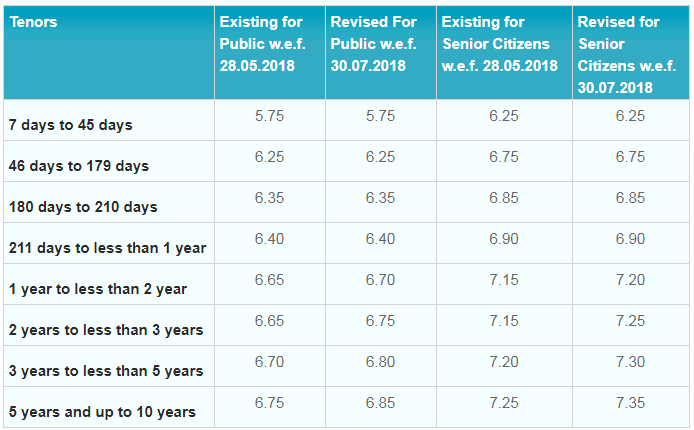
As for between 1 year to less than 2 year, SBI gives 6.70% to normal category, while 7.20% to senior citizen. From 2 years to less than 3 years, 6.75% rate is offered and 7.25% to senior citizens. Meanwhile, for 3 years to less than 5 years, SBI gives 6.80% to normal ones and 7.30% to senior citizens. The highest interest rate is given for tenure between 5 years to 10 years, at 6.85% to normal category and 7.35% to senior citizens.
Coming to largest private lender HDFC Bank, it gives 7.30% to normal and 7.80% to senior citizen for tenure of 1 years and till 2 years. The highest interest rate given by the bank would be 7.40% to normal ones and 7.90% for a tenure of 2 years to 3 years. 
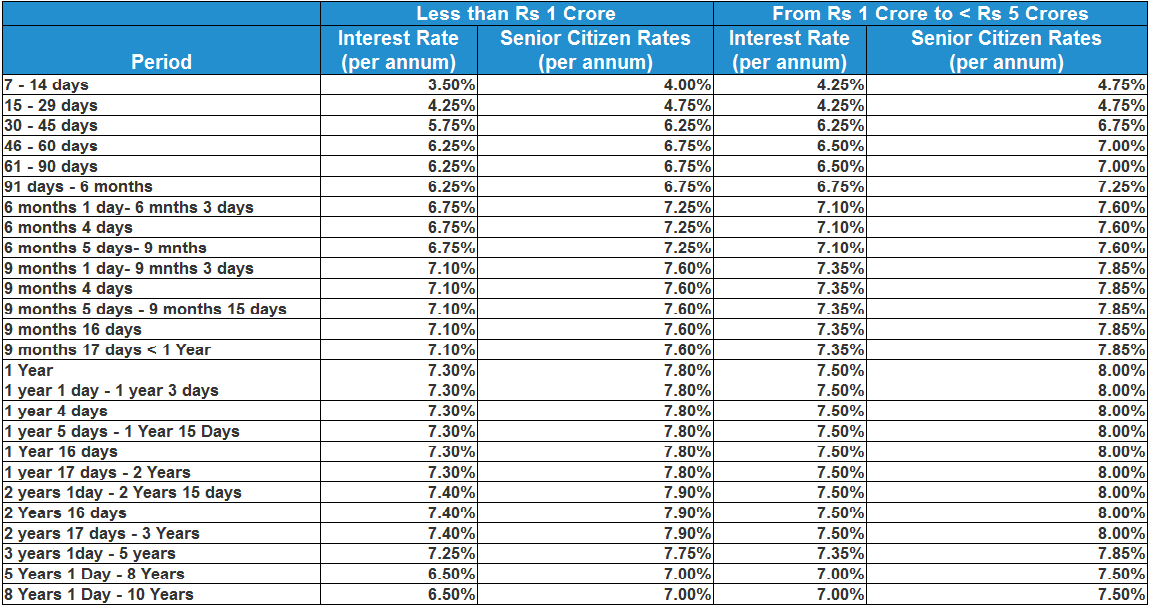
After the third year, the HDFC Bank's deposit rates have started to decline, as it stood at 7.25% (normal ones) and 7.75% (senior citizen) for 3 years to 5 years tenure, while was at 6.50% (normal ones) and 7% (senior citizen) for 5 years to 10 years tenure.
Hence, all eyes will now watch when SBI will nudge and provide a some hike in their FD rates. The last time SBI made a hike in FDs was in the end of July month this year. 

Thursday, 11 October 2018

Anil Singhvi's Market Strategy October 12: Oil & Gas, Aviation are Positive, Metals Negative

In tandem with the weakness in the global markets, the Indian stock markets closed in the red on October 11, 2018. Nifty closed down by 225.45 points or 2.16 per cent at 10,234.65 while S&P BSE Sensex was down by over 759.74 points or 2.19 per cent to close at 34,001.15. 
OMCs gained handsomely with HPCL gaining by over 16.21 per cent while IOC gained 5.77 per cent and BPCL gained 4.84 per cent. However, NBFCs were hammered once again after a brief respite yesterday and Bajaj Finserv and Indiabulls Housing were down by 6.20 per cent and 9.12 per cent.
Amid positive domestic institutional investors (DIIs), neutral future and option (F&O), global market, negative foreign institutional investors (FII) and weak sentiment cues, the short-term trend of the Indian market is likely to be negative on October 12, 2018, the last day of the week to trade in the market.
Zee Business's Managing Editor Anil Singhvi's Market Strategy for October 12: 
Nifty broke stop loss level on intraday and closing basis yesterday.
10,250 and 24,750 are going to be the deciding levels on Nifty and BankNifty. 
The small trading range on Nifty stands at 10,135-10,335 while the bigger and extreme trading range lies between 10,050-10,400 and 9,950-10,500 respectively. 
The small and bigger trading range in the case of BankNifty lies in the range of 24,500-25,000 and 24,250-25,300. 
Risk of a fall up to 24,000 can be seen in coming days if BankNifty breaks below 24,250 on the intraday basis or closes below the mark of 24,400. 
Traders can increase their buying positions on the two indices, Nifty and BankNifty close above the mark of 10,500 and 25,000 respectively.  

Sell Nifty in 10,400-10,475 range with stop loss 10,500 and target 10,350-10,300. 
 
Buy and Sell Strategy on BankNifty 
Buy BankNifty with a stop loss of 24,500 and target 24,950-25,200-25,300. 
Sell BankNifty in 25000-25200 range with a stop loss 25,350 and target 24,950-24,750. 
In F&O Ban: IDBI
 
The put-call ratio (PCR) stands at 1.08 and the volatility index (VIX) is 20.55. 
 
Sectors:
Positive: Oil & Gas, Aviation
Negative: Metals
 
Result Analysis:
TCS: Results in-line, Commentary very good, double-digit growth due to a weak rupee. 1850-1900 buy zone and 2100 is the higher range.
Stock of the Day: 
Buy IOC Futures: Stop loss of 129 and target 134, 137

Buy Spicejet: Stop loss 69 and target 72.50, 74

Tuesday, 9 October 2018

Markets in turmoil, but stay invested if you want to get handsome returns

Thane-based Amol Bhosekar, 43, is a pharmaceutical research professional. He started investing in mutual funds through systematic investment plans (SIPs) in 2008. Until then, his investments were in conventional instruments like bank fixed deposits and insurance policies, from which he was earning returns in the range of 7% to 8%. "At one point of time, I realised these returns will not help me fulfill my financial goals," he said.
In 2008, he started investing between Rs 5,000 and Rs 7,000 per month and increased the amount gradually. By August 2018, his monthly investments in MFs had increased to Rs 35,000. September onwards he increased this amount by Rs 15,000 and currently he invests Rs 50,000 in different MF schemes, every month, out of his salary of Rs 2 lakh. Bhosekar believes that at least 30% of one's monthly income should go towards investments.
"Slaried people don't have money in bulk for meeting contingencies. That is why they can opt for SIP for investing. If you want to benefit from SIPs, you should stay invested at least for three years. And if you want to get handsome returns then stay invested for 10 to 15 years," he said.
Besides, getting professional advice from Chitnis Financial Planners, he reads a lot about personal finance in books, magazines, newspapers and on the internet. "It is better to learn your finances than to depend fully on advisors. After all, it is your own money," he said. He uses calculators available on websites to calculate the cost of financial goals in future. About his strategy he said: "Always link at least one financial goal with your MF scheme."
Bhosekar's goals are securing his daughter's education and marriage. His tips for being an ace investor in MF include: one, choosing right financial adviser and two, selecting a good set of MF schemes.
"You can earn in the range of 12% to 15% if you pick the right MF and stay invested in it for long time," he added.
Why investors must not stop SIPs
Bhosekar's expectations can be proved by numbers, as Milind Chitnis, founder of Chitnis Financial Planners explained. Suppose an investor was making a monthly SIP of Rs 9,000 for nine months, from January to September 2008. In September 2008, his investment was Rs 90,000 and the gain was Rs 82,000, as equity markets were down. He would have had to bear a loss of Rs 8,000. If the investor had stopped the SIP and looked for "safer" avenues; say bank FDs, PPF, NPS or KVP, by September 2018 he would have got Rs 3,20,000 as returns.
But if the same investor would have continued investing in SIPs, he would have invested Rs 12,90,000 by now and got Rs 31,78,000 returns. This is the reason why investors should never stop SIPs, Chitnis he said. In fact, low markets are a boom period for SIP investors, as they can buy their units at lower prices," he said.
Ashwin Patni, Head Products and Fund Manager, Axis Asset Management Company agreed that equities are a long term asset class. "Investing systematically can reduce the risks of timing the markets and playing a long term investment cycle, thus reaping the true rewards of equity investments," he said. As against this, traditional savings instruments provide a fixed rate of return, are tax inefficient and don't account for the effects of inflation.
G Pradeepkumar, CEO, Union Asset Management Company also has the same advice for investors. Once you pick good schemes and put in place SIPs, you should stick to these plans. "Never start investing randomly. Increase SIPs when the markets are down as you will get cheaper units. And to get full benefits, keep on investing for at least five years," he said.
Loss can be recouped
Fifty-five year old Vijay Zope, a medical practitioner based in Mumbai, lost Rs 20-25 lakh in the aftermath of the stock market scams involving brokers Harshad Mehta and Ketan Parekh. Before he fully switched to SIPs, Zope was an active investor in direct equity market. For the past 35 years, he has seen markets peaking new highs and falling to record lows.
Now, he has chosen different types of MFs for investing money. Presently, he invests around Rs 50,000 in MFs every month using SIPs. He started his SIP investments around 2001 and within three to four years recovered the money he lost in the stock market.
Zope is also a firm believer that for an individual investor, MF investment, through SIPs is the best option. "It is difficult for an individual to track the live equity market every day. Even big names in the market can't do that with an ease," he said.
For an individual investor, there is no need to press the panic button when the markets are down. In fact, he suggests people should invest more when the markets are in turmoil.
Lack of planning can hurt returns
Fifty-year old Mahesh Vaknalli works in a private company in Mumbai. He started investing in stocks in early 90s, when he started working. His market investments were not properly planned and that caused him a loss of Rs 1 lakh. He blames the loss on the lack of "proper planning" and the absence of a good "philosophical friend-cum-investment adviser".
"As an investor you should ensure that your money does not get drained and you get an assured return," he said. So, what is an assured return? "It is something where your money is not lost and your primary capital is intact," he said.
During his early days of investing, Vaknalli would invest in traditional investment tools. His favourite picks were FDs, recurring deposits, recurring cumulative deposits etc. In 2003, he got introduced to MFs and SIPs, through his fried. Since then, there was no looking back. In the beginning, Vankalli would set aside less than 5% of his monthly salary for MF investments. At that point of time it was about Rs 2,000 to Rs 3,000 per month. Vankalli's advice to new investors is to start with a basic minimum amount. They should not get bogged down by ups and downs of the market.
He continued with his investments even during the global financial crisis of 2008. Even today, he stays invested despite markets being in a turmoil. For him, "notional loss" and "temporary setback" are meaningless.
"I consider MF an institution. The whole mechanism of MFs offered me various solutions; short term, medium term and long term. They helped me in fulfilling my specific goals and chalking out my retirement plans," he said.
Today, Vankalli has close to 10-15 different MFs in his kitty. "Now I invest around Rs 75,000-80,000 every month in MF. That is roughly 25% of my monthly salary." When asked what it takes to be a successful investor? He said, "It is important for you to have a philosopher-cum-fried-cum- adviser by your side, always."

Monday, 8 October 2018

SBI vs HDFC vs PNB vs ICICI vs Kotak Mahindra vs BoB vs Axis Bank: Personal loan interest rates compared

Personal loans offered by various banks come handy in times of crisis. And, also in good times when one falls short of cash. All banks provide personal loans but their respective rate of interests differ. The processing fee required to get the personal loan also varies from bank to bank. One of the cheapest personal loan rate is offered by IDBI Bank (12-14%) and it also comes with one of the cheapest processing fee (1% of the loan amount). The highest personal loan rate offered by banks goes up to 24% (Axis bank), while the minimum processing fee of Rs 1000 is offered by Bank of Baroda. 
Here we take a look at the various home loan rates offered by several banks right now: 
State Bank of India: 11.00-15.40%; Processing fee is 1%. One can take minimum Rs 25,000 personal loan and maximum Rs 15 lakh from SBI. 
ICICI Bank: 11.10-18.00%; Processing fee is up to 2.5% of the loan amount. One can take minimum Rs 50,000 personal loan and maximum Rs 30 lakh from ICICI. 
HDFC Bank: 10.99-18.00%; Processing fee is up to 2%. One can take minimum Rs 50,000 personal loan and maximum Rs 40 lakh from HDFC Bank. 
Axis Bank: 11.49-24.00%; Processing fee is 1.5-2%; One can take minimum Rs 50,000 personal loan and maximum Rs 40 lakh from Axis Bank. 
Punjab and National Bank: 11.25-15.00%; Processing fee 1.8% of the loan amount; One can take minimum Rs 50,000 personal loan and maximum Rs 10 lakh from PNB.
Bank of Baroda: 11.55 and above; Processing fee is 2% of loan amount (Minimum Rs 1,000 and Maximum Rs 10,000);  One can take minimum Rs 50,000 personal loan and maximum Rs 10 lakh from BoB.
Citibank: 10.99-14.25%; Processing fee is up to 3%;  One can take minimum Rs 1 lakh personal loan and maximum Rs 35 lakh from Citibank.
IDBI Bank: 12.00-14.00%; Processing fee is 1% of the loan amount;  One can take minimum Rs 25,000 personal loan and maximum Rs 10 lakh from IDBI Bank.
Yes Bank: 10.75-16.99%; Processing fee is 1% of the loan amount;  One can take minimum Rs 1 lakh personal loan and maximum Rs 30 lakh from Yes Bank.
UCO Bank: 11.40-12.80%; Processing fee is up to 1% of the loan amount;  One can take up to Rs 10 lakh personal loan from UCO Bank.
Kotak Mahindra Bank: 10.99-19.50%; Processing fee is up to 2.5% of the loan amount;  One can take minimum Rs 50,000 personal loan and maximum Rs 30 lakh from KMB.
RBL Bank: 11.99-19.00%; Processing fee is 2% of the loan amount;  One can take minimum Rs 1 lakh personal loan and maximum Rs 20 lakh from RBL Bank.
IDFC Bank: 11.49-14.49%; Processing fee is up to 2% of the loan amount; One can take minimum Rs 1 lakh personal loan and maximum Rs 20 lakh from IDFC Bank.
Ahead of the Reserve Bank of India's monetary policy announcement, several banks including HDFC, PNB, and SBI had increased their lending rate. SBI increased its one-year MCLR from 8.45% to 8.50%. Similarly, ICICI bank increased its six-month MCLR from 8.5% to 8.6% and one-year MCLR to 8.65% from 8.55%. Several other banks are expected to increase their base lending rate on coming months, even as the Reserve Bank of India has not hiked the repo rate. 

Thursday, 4 October 2018

Mutual Fund Tip: Want to earn additional 1-1.5% returns? Why it would be wrong

During the last few years, Indian economy has seen huge participation by retail investors in mutual fund investments.
During the last few years, Indian economy has seen huge participation by retail investors in mutual fund investments. If you are an existing MF investor or someone wanting to invest in a MF, you must be aware about the direct and regular MF schemes. The only difference between direct funds and regular funds is that in the former investor does not pay any commission or brokerage to the distributor/broker. The overall portfolio, scheme's structure and investing strategies for both regular or direct plan of any scheme will remain same.
There is a lot of debate going around this topic and investors are constantly facing the dilemma of which to choose. I am sure, you must have heard a lot about how direct MFs can help you save lakhs of rupees (how you can earn additional 1-1.5% returns) over a period of 20 or 25 years. In fact, there are many advertisements floating around highlighting this cost saving as the main benefit. So, does that mean that you can simply follow a Do It Yourself method and buy any direct fund? The answer depends on many parameters. You should not rush to invest in a direct fund until you are clear about all the pros and cons.
The most important factor in this debate of direct v/s regular fund is to find out the main objective, which hardly gets discussed. I suggest you shift the focus from saving cost to a larger objective. If I were to ask you about your objective behind investing money, you would mention earning returns and creating wealth. Saving cost is never the objective, though it does play an important role in every financial decision.
The priority for investors should be to draw up a comprehensive financial planning, by setting clear measurable financial goals, with a road map for achieving the same. Decisions like which products and schemes to invest in, what returns to expect are the next steps.
There are hundreds of MF schemes to select from and choosing which schemes to invest in requires expertise. A wrong fund selection can get you a lower return than expected. In fact, the gap between the best or worst scheme could be as high as 5-10%.
Your investment needs a constant monitoring and regular review to re-balance. In case a change in the economic situation has the likelihood of impacting your goal planning, a trusted financial advisor will help you optimise the performance of your portfolio and help it outperform the market.
Your financial advisor will also handhold you during the time of distress and market volatility. At such times investors tend to take rash decisions, which could impact their portfolio negatively.
The other option is to have a fee-based financial advisor, who along with fees and a share in profits (if it crosses a certain percentage), can help you select the right plans. This will help you save the brokerage part involved in regular plan and also make your advisor more accountable, as his income will depend on the returns your investments generate.
Instead of debating about direct or regular plans, you should think about your main objective of achieving the financial goals you have set. Focusing on earning higher returns and achieving your financial milestones are a bigger objective than saving cost.
In case you are already sorted out with your goals and can spend time, energy and possess the necessary expertise, then investing is simple for you. In that case, going direct and saving even a 0.1% cost makes complete sense.

Wednesday, 3 October 2018

Indian Rupee plunges to new all-time low of 73.77, sheds 43 paise against US dollar

The domestic currency closed at a record low of 73.34, down by 43 paise or 0.59 per cent at the interbank foreign exchange

A day after hitting an all-time low, the Indian rupee repeated the dose and started on a very dismal note on Thursday. The rupee hit a new low of 73.77 after it plunged 43 paise against US dollar. On Wednesday, the Indian rupee plunged by 43 paise to breach the historic low of 73 level as soaring crude oil prices fuelled worries over capital outflows and widening current account deficit. The domestic currency closed at a record low of 73.34, down by 43 paise or 0.59 per cent at the interbank foreign exchange.
In the day trade yesterday, the rupee crashed to its all-time low of 73.42 per dollar as crude oil prices breached the USD 85 per barrel mark, leading to huge outflows of cash. Investors remained concerned over sustained foreign capital outflows and soaring crude oil prices, analysts said. After breaching the US 85 per barrel level, the benchmark Brent crude stayed near four-year high levels at USD 84.86 per barrel.
According to the provisional exchange data, foreign investors withdrew Rs 1,550 crore on a net basis from capital markets on Wednesday. Rising US interest rates and bond yields have encouraged investors to pull out funds from emerging markets to pocket better returns, analysts said. "The rupee has made a new record low today on the back of consistent rise in the crude oil prices. A sharp rise in crude oil along with steep depreciation in the rupee might push inflation higher in coming months," Rushabh Maru - Research Analyst, Anand Rathi Shares and Stock Brokers.
The Reserve Bank refused to open a special window for oil marketing companies which affected market sentiments, VK Sharma, Head Private Client Group & Capital Market Strategy at HDFC Securities. Stocks also fell by more than 1.5 per cent due to the rupee falling to record low levels. The benchmark BSE Sensex plunged by 550 points or 1.51 per cent while the broader Nifty tanked 150 points or 1.38 per cent.
The rupee opened lower at 73.26 per dollar due to high crude oil prices against the last close of 72.91 per dollar. The currency pared some losses to touch a high of 72.90 per dollar on market speculation that RBI may open special dollar window for oil companies.
However, without any clear signals from the central bank, the rupee crashed to all-time lows before settling at 73.34. Meanwhile, the FBIL set the reference rate for the dollar at 73.02 per dollar. The reference rate for euro was fixed at 84.57 against 84.37 previously and for the British pound at 94.98 against 94.88 on October 1.

Indian rupee suffers big crude blow, RBI scrambles, orders risky move

The rupee, which has weakened 14.82% this calendar year, opened at 73.26 against the dollar on Wednesday.
Reserve Bank of India (RBI) countered the rupee fall on Wednesday by allowing oil marketing companies (OMCs) to raise foreign loans to fund their working capital needs under the automatic route with immediate effect. With the rupee closing at Rs 73.34 against the dollar and Brent price touching $85 a barrel, RBI was forced to push the oil companies demand for dollars out of the market.   
The rupee, which has weakened 14.82% this calendar year, opened at 73.26 against the dollar on Wednesday, lower than its previous close of Rs 72.91 and hit a new all-time low of Rs 73.41 during the day. By taking the oil marketing companies away from the market, RBI hopes to keep the demand for dollars under check.
“All state-run OMCs will now be able to raise external commercial borrowings (ECBs) for working capital purposes with a minimum average maturity of three to five years from all recognised lenders under the automatic route,” the central bank said in a late evening release.
The $750 million cap for individual state-run refiners has been waived off while the overall annual foreign currency borrowing under the new norms has been capped at $10 billion with immediate effect. Under the current regulations, the OMCs are allowed to raise ECBs from direct or indirect shareholders or group companies if the loan is for an average maturity of five years.
“This will allow the country to borrow foreign currency from the market via the oil companies,” Ananth Narayan, a currency expert and professor at SP Jain Institute of Management, said.
“In the short run, this should take away the demand for dollars and help strengthen the rupee. Of course, the oil companies will take on a substantial currency risk. While this is a good step to control the short-term sentiment and buy us time, we still need to address our core issues around the current account deficit,” Narayan said.
Conscious of the forex risk, RBI has asked the OMCs to have a Board approved forex mark-to-market procedure and prudent risk management policy, for such ECBs.
“The last time when RBI had opened a similar window in 2013 there was also a swap window of the central bank, but this time the Boards have to decide on the hedging mechanism. The rates in the overseas markets are also not soft, there is liquidity but it will come at a cost,” said Bhaskar Panda senior vice-president, treasury advisory group, HDFC Bank. The swap window subsidised some of the borrowing cost for the companies.
According to the provisional data from Securities and Exchange Board of India on the foreign inflows into equities show that investors  withdrew Rs 1,550 crore on a net basis from capital markets on Wednesday.
The dollar index improved by 1.2% to 1.3%, which led to the dollar appreciating against a host of Asian currencies and also to the euro and yen after news came in that US added a record number of jobs.
“The oil window will be a  great relief for the market,” Ritesh Bhansali, assistant vice-president, forex risk consulting, Mecklai Financial.
The dollar index improving and the foreign investors withdrawing money from Indian equities is creating a scarcity of dollars in the domestic market. “Foreign portfolio investors have withdrawn $3 billion from the Indian markets in September alone, which is putting tremendous pressure on the rupee. The escalating oil prices is another big dampener,” Bhansali said.

Friday, 28 September 2018

Tata Group retains Delhi's iconic hotel Taj Mansingh in NDMC auction


Delhi's iconic hotel Taj Mansingh was retained by the Tatas in an auction by the NDMC

HIGHLIGHTS

  • Tatas defeated the ITC group who were also bidding
  • The auction was pending since the lease had expired in 2011
  • The lease for the hotel will be granted to the group for 33 years
The Tata Group retained the iconic Taj Mansingh Hotel in Lutyens' Delhi in an auction by the New Delhi Municipal Council (NDMC) on Friday after years of litigation at doubled license fees, an official said.
The fiercely fought auction with rival group ITC, also bidding for the hotel, began 11 am and ended 4 pm.
The auction was pending since the lease had expired in 2011 and the Tata group were operating the property on temporary extensions.
The lease for the hotel will be granted to the group for 33 years at double the license fees.
"The Tata group's Indian Hotels Company Limited (IHCL) has retained the property at a license fees of Rs 7.03 crore per month including GST or 32.50 per cent of the gross turnover of the property. Earlier, they were paying Rs 3.94 crore per month as license fees," a senior NDMC official told PTI.
Failing to auction the luxury hotel in two attempts, the NDMC had last month decided to relax the eligibility criteria for bidders and reduce the minimum number of bids required.
The auction had to be put off twice as it got less than the required number of bids for the five-star property to go under the hammer.
Earlier, the civic body had issued an annulment notice for the e-auction in June when it had to be cancelled as only IHCL -- the existing operator -- had submitted its bid for retaining the property.
The Taj Mansingh was given to the Tata group in 1978 on a lease for 33 years, which ended in 2011. The company was since given nine temporary extensions.
However, the civic body could not auction the property then as it was tied up in a legal battle with the IHCL.
"We are delighted that the iconic Taj Mahal, New Delhi which has been an important part of the cultural and historic fabric of the national capital, will continue to remain a part of the IHCL family," Puneet Chhatwal, managing director and chief executive officer, IHCL, said.
"We would like to thank our customers for their enthusiastic support and our employees, who have always offered exceptional service to our guests for over 40 years.
"We look forward to investing in the hotel and taking it to new heights of Indian hospitality. The Taj legend will continue to serve Delhi with elegance and charm," he said.

Does stress in early childhood have larger impact in the later years?

Stress in childhood and adulthood has combined impact on hormone patterns and ultimately in health outcomes, a recent study suggest...